




THE AUTHOR
MUSIC BOOKS
HISTORY BOOKS
THE BAND
CONTACT US

Each of these histories provides the general reader with an accurate summary of the province's development from prehistoric to modern times, including the broad outline of major developments such as exploration, settlement, economic growth, and social and political development. Relations with the federal government are explained from the province's point of view. Each book is approximately 70 pages, containing 10-12 chapters, an index and a map of the province on the cover in the official provincial colours. Each book has been checked for accuracy, balance and readability by over half a dozen professional Canadian historians, editors, analysts and general readers. Price: $7.95.
 A Short History of Manitoba mentions in particular the Riel Resistance, the School Question, provincial rights, the rise and relative decline of Winnipeg, the growing conservatism of politics, and the way the Depression changed the province from a champion of provincial rights into a defender of strong federalism. ISBN0-920002-15-3
 A Short History of Saskatchewan mentions in particular the North-West Rebellion, the achievement and limitations on provincial status in 1905, the way government handled successfully the problems facing a one-crop economy, the devastation of the Depression, the achievements of Canada's first socialist government, the introduction of Medicare, and the struggle to diversify the economy. ISBN 0-9694667-3-0
 A Short History of Alberta mentions in particular the era of ranching, the achievement and limitations on provincial status in 1905, the revolt of the farmers, the way the Depression led to the radical Social Credit Government, and the way that government and the succeeding Conservative one successfully defended the province's interests and addressed its problems. ISBN 0-9694667-2-2
 A Short History of BC mentions in particular the gold rush, Confederation and the problems implementing it, the growth of the province before World War I, the Depression, the spectacular development of the province during and after World War II, the Social Credit regime of "Wacky" Bennett, and the period up to the mid 1980s. ISBN 0-9694667-4-9
 A Short History of Ontario covers settlement, the War of 1812, the Rebellions of 1837, Confederation, the growth of the province before World War I, Prohibition, the Depression, the development of the province during and after World War II, the Conservative regime, and the period up to the mid 1980s. This book won a medal from the Speaker of the Ontario Legislative Assembly.ISBN 978-0-9694667-6-5.
 A Short History of Quebec covers the French regime and settlement, British conquest, economic development and British settlement, the growth of Montreal, the World Wars and Depression, the Duplessis regime, the Quiet Revolution, the Parti Quebecois and separatism, and developments in the 1980s and 1990s. ISBN 978-0-9694667-8-9.
 A Short History of Nova Scotia mentions the expulsion of the Acadians, the arrival of the Loyalists, Responsible Government, the disastrous Confederation arrangement, one-party dominance, the 1920-39 depression, de-industrialization and strikes, post-war stagnation, and the revival under Robert Stanfield. ISBN 978-0-9694667-9-6.
 A Short History of New Brunswick deals with the arrival of the Loyalists and the Acadians, the development of the timber trade, reform and Responsible Government, the rejection and then acceptance of Confederation, economic developments in the twentieth century, the Robichaud Revolution and the Hatfield years. ISBN 97809865967604
 A Short History of Prince Edward Island covers the land problem, settlement, the Golden Age, the struggle to avoid Confederation, economic stagnation and out-migration, the world wars and Depression, post-war economic development, and The Plan under Alex Campbell. ISBN 9780986596711
 A Short History of Newfoundland and Labrador mentions in particular the cod fishery, the difficulty of diversifying the economy, the slow and uneven development of settlement and institutions, the Golden Age prior to the First World War, the loss of independence during the Depression, Confederation in 1949, and post-Confederation developments. ISBN 978-0-9865967-3-5
The late Senator Murray Sinclair said repeatedly that the solutions to the many problems with Indigenous peoples began with understanding their relations with settlers and white society. That message has been repeated by hundreds of Indigenous leaders, politicians, journalists, and studies.
 A Short History of the Canadian North mentions in particular the slow pace of exploration, the fur trade and the whaling industry, the Klondike Gold Rush, Canadian sovereignty and the role of the police, the Second World War, the policy of assimilating the Aboriginal population, and the slow and uneven economic and political developments before 2000. ISBN 978-0-9865967-2-8
Understanding First Nations: The Legacy of Canadian Colonialism
This 180-page book sets out to do just that. And it is written by someone who has studied Canadian history for decades, written histories of every province, and lived in four regions of Canada. I grew up near the Sioux Valley Reserve in western Manitoba and was always interested in "Indian" issues. I went to pow-wows, wore moccasins, made beadwork, had a bow and arrow, spent a holiday on a reserve, and could draw a map of North America with the location of the major tribes. I could explain why it took decades for the American cavalry to defeat those tribes. During a career in the Canadian Foreign Service I was also engaged in providing support for Canadians in distress abroad and in promoting human rights. The latter could be embarrassing if foreigners knew of Canada's abuse of Indigenous peoples!
The book covers every aspect of the relationship between First Nations and the Canadian government. The stories of the Metis and Inuit are very different -- adding those would make for a very long and complicated text as would dealing with the relationships between First Nations and provincial governments. A short book covering 17 subjects, easy-to-read, factually correct, was what we wanted to produce and what we did.
Chapter 1 explains one of the biggest problems and the fact it has never been resolved, like so many others. It is the federal government, the settler, white, government that defines who Indians are legally. That power was used to exclude Indians from treaty money and to discriminate against women. That has not changed. Chapter 2 and 3 cover the historical background and some still popular myths whites entertain about First Nations (FN). Chapter 4 explains the very complex issue of sovereignty -- FN never believed they had it and Ottawa's claim is based on the myth that Europeans "discovered" Canada!
Chapters 5 and 6 explain the Treaties, why they had to be negotiated, how they were violated by Ottawa from the beginning, how the FN were forced onto poor land and the reserves were gradually reduced in size. Chapter 7 covers the Indian Act which reduced the FN to the status of children in violation of the Treaties and Chapter 8 points out that FN villages were quite well governed until Ottawa replaced those systems with ones that did not, were controlled by Ottawa, and excluded women. Chapter 9 deals in depth with the Residential Schools, the effects of which are still evident in the FN population and the reluctance of the federal government to address those effects.
Chapter 10 explains the very high incarceration rates for FN people, and Chapters 11 and 12 address the many problems with welfare and the missing and murdered women and men, all of which reflect the continuing colonial mentality of the federal government. The next four chapters address infrastructure, consultations, land claims and the question of why there is so little progress. Finally, Chapter 17 looks at Reconciliation and Political Correctness, issues like the rather odd attempt to make Sir John A. Macdonald disappear from history when the Indian Act was Liberal legislation, the Liberals criticized him for providing too much aid to starving FN, the Laurier regime took back most of the reserve land, and almost all the suffering in Residential Schools took place after he died. A 7-page bibliography completes the book. Reviews are available.
But much progress has been made and the rate is accelerating. Copies of this book were donated to every MP, Senator, MLA and Councillor in large cities. There is no excuse for not Understanding First Nations. ISBN 9 780986 596742
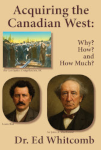 Acquiring the Canadian West: Why? How? and How Much?
This book examines how the new and tiny Dominion of Canada had, as one of its major goals in 1867, to acquire one-quarter of North America and create a state stretching from the sea to sea. The Dominion consisted of four provinces huddled along the St. Lawrence and in the Maritimes with a population of a mere 3.5 million. Part of the solution to its problems was seen as expansion to the Pacific. Everyone understood that the dream would be a monumental challenge; many thought it was madness.
Canadian nationalist historians and others, like people everywhere, like to exaggerate their peoples' achievements, so the role of Canadians in the acquisition and settlement of the West is largely attributed to the politicians, businessmen, and people of the new Dominion, the pioneers who overcame incredible obstacles, the North-West Mounted Police who brought peace to the prairies and saved the First Nations from the fate their brothers suffered south of the border, the genius of the architects of the CPR who conquered the mighty Rockies, the navies who built the railway.
While much of this is true, much is distorted or ignored. This book tells the full story.
First of all, the British Government was adamantly determined to see its North American colonies united so it could reduce the costs of administering its Empire. It ensured that the Hudson's Bay Company sold Rupert's Land to the Canadian Government and gave British Columbia no other option than to join on terms that could not be fulfilled. To gain legal ownership of the prairies, the Canadian Government negotiated treaties with the First Nations which, it claimed incorrectly, "ceded" the land, and then immediately failed to fulfill the promises it made, which it still does.
The mishandling of Metis land claims provoked the Red River Resistance and the North-West Rebellion, suppressed by excessive force and at great cost. The former led to the premature creation of the Province of Manitoba, the latter was used to reduce the innocent First Nations to the status of children. The building of the CPR was, in fact, an incredible achievement and was essential to the success and future of the new Dominion. But it was built over the wrong route in northern Ontario, over the wrong pass in the Rockies, and at a speed which required the use of Chinese labour creating costs and problems that lasted for generations.
The prairies were opened for settlement, but these factors combined with a land policy that kept much fertile land off the market actually made the prairies unattractive for settlement compared to the United States, Australia, and Argentina. Canada then stagnated in the three decades after Confederation and its goals were only realized after 1896 when good land in the United States had all been settled.
Still, the West was acquired, the price for Rupert's Land was modest, BC did join extending the Dominion from "sea to sea" the First Nations were pacified without wars, the CPR got built, and the enormous prairies were surveyed and eventually settled. The Canadian Dream was realized, an amazing achievement almost unique in history in terms of the challenges faced and overcome by such a tiny colony, even if mistakes delayed it for decades. This book is also unique in estimating the costs of all aspects of acquiring the Canadian West, and they were enormous, partly because of the mistakes made. Those, however, were mostly understandable. People make mistakes, even Canadians! Reviews are available. ISBN 9-780889 702615
 Rivals for Power: Ottawa and the Provinces, the contentious history of the Canadian federation. This is a comprehensive, 350-page history of federalism, factually-sound but written for the general reader. It begins with several chapters on the background to Confederation and its achievement and an analysis of the British North American Act. Every province entered Confederation differently and each one has had a different relationship with Ottawa -- all those variations are explored in detail. John A. Macdonald implemented the new system and by 1896 it was clear that Canada had a genuine federal system and not the central-dominated one he wanted.
The Laurier years were the Golden Age of federalism, but the First World War and new trends in the twentieth century increasingly blurred the line between federal and provincial responsibilities, mainly with federal involvement in provincial affairs. The Depression was a disaster for federalism and Canadians and the Second World War and post-war period resumed the trend towards federal involvement in provincial matters. Since Ottawa reflected primarily English-Canadian values and desires, Quebec increasingly objected to federal interference setting the stage for Quebec separatism and the constitutional battles that dominated politics from the 1960s to the 1990s. Eventually both federal and provincial politicians from both Quebec and elsewhere seemed to accept that most Canadian problems require the attention of all three levels of government, and federalism today reflects hundreds of compromises and agreements far removed from the constitution of 1867 which, oddly, has never been amended to reflect most of these changes. But politics and history never ends, and no one knows what Canadian federalism will look like a decade or more from the 150th anniversary. This book reflects the fact that the author wrote histories of all ten provinces and spent his career in the federal civil service and can therefore see federalism from many different perspectives. As a historian and diplomat he also studied centre-regional relations in a dozen foreign countries and can therefore place Canadian federalism in an international context. The book is based on 40 original documents and over 400 secondary sources.
A SHORT HISTORY OF ALBERTA
TABLE OF CONTENTS
| Preface | ||
| 1. | The Alberta of the Indians, to 1860 | 1 |
| 2. | From British to Canadian Colony, 1860-1870 | 6 |
| 3. | Land, Railways and Stagnation, 1870-1880 | 10 |
| 4. | The Era of the Cattlemen, 1880-1896 | 16 |
| 5. | The Great Boom, 1896-1905 | 21 |
| 6. | Provincial Status, 1905-1910 | 27 |
| 7. | War, Reform and Angry Farmers, 1910-1920 | 32 |
| 8. | The Farmersâ Government, 1920-1935 | 38 |
| 9. | The Rise of Social Credit, 1935-1940 | 44 |
| 10. | The Era of Social Credit, 1940-1970 | 51 |
| 11. | Conservative Alberta, 1970-85 | 58 |
| Index | 62 | |